A Complete Record of Creation, Betrayal, and the Birth of the Races
Ancient tablets reveal the cosmic origins of Arcadia, from primordial gods to the five mortal races.
Article · June 2026
Overview
Recovered Loeic tablets chronicle the creation myth of Arcadia, detailing how primordial beings Einvaldi and Annuler gave birth to the gods, their betrayal and murder by Niefel and Udrar, and Annuler's vengeful pursuit that led to her death and the world's formation from her body. The narrative continues through the gods' punishment of the traitors, Niefel's creation of monstrous serpents from the Underworld, and the eventual birth of five mortal races through divine covenant.
What follows is drawn from the Echoes of Origin, recovered by the Mosaic Caravan during their final journey across Arcadia. Carved in Loeic and translated by Arin researchers, these records represent the oldest known account of creation, the first betrayal, the punishment of the gods, and the birth of the five races. They are presented here in the order in which the events occurred, not the order in which the tablets were discovered.
Part I — The First Tablets: Of Creation and Betrayal
Lootian Cosmic Era 9,847
In the void before time, two beings dwelt alone. Einvaldi and Annuler moved through emptiness, bound together yet opposing, each the balance to the other's nature. The silence grew heavy upon them. From their union came forth the Elder Gods: Kempe the Champion, Fagra the Beautiful, Prevti the Generous, Udrar the Warring, and Viss the Wise.
Yet the primordial pair found no rest in their offspring. They brought forth also the World Gods: Jord of the land, Ver of the sea, Horis of the sky, Niefel of the Underworld, and Artimia of the flame. The cosmos rang with voices and movement where once silence reigned. Einvaldi grew wrathful at this clamor.
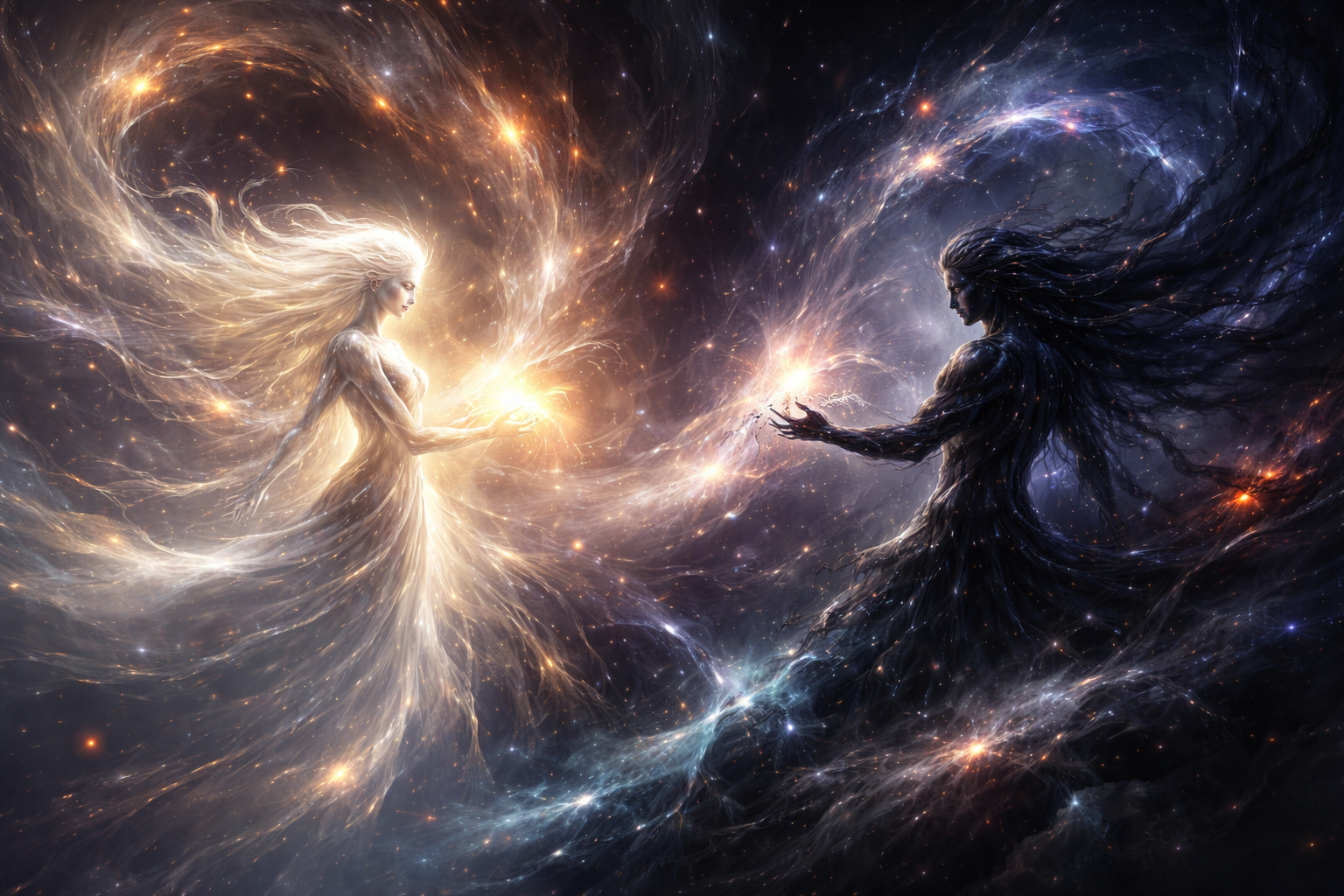
While Einvaldi slumbered, treachery stirred. Niefel and Udrar, consumed by fear, crept upon their creator with blades drawn. They struck down Einvaldi in his sleep and fled into shadow. When Annuler discovered her mate's corpse, grief transformed into rage that shook the foundations of existence. The betrayers whispered poison in her ears, claiming all the gods had conspired in murder.
Annuler descended into chaos absolute. She pursued her children across the void, seeking to unmake all she had helped create. The gods fled before her wrath and turned to Kempe in desperation. They offered him their power if he would stand against their mother.
Viss gave intelligence. Fagra bestowed youth. Prevti granted generosity. Jord yielded dominion over earth. Ver surrendered mastery of water. Horis offered command of wind and lightning. Artimia delivered power over flame. Thus armed with the strength of all creation, Kempe faced Annuler in battle.
For days and nights beyond counting they strove against each other. Kempe wove a great net of wind, earth, fire, and water, casting it wide to snare his mother. At last he trapped her thrashing limbs within the earth itself. Then Kempe raised the great sword Einvaldi Vault, Sovereign Wills It, and struck down Annuler, dividing her into many pieces.
Her sundered flesh became the landmasses of Arcadia. Her bones turned to ore and stone beneath the ground. Her blood filled the oceans, which Kempe purified into clear seawater. Thus from betrayal and battle was the world born, and from death came life.
But justice remained unfinished. The betrayers still walked among the gods.
Part II — The Judgment of Traitors
Lootian Cosmic Era 9,846
When the world lay newly formed from Annuler's divided flesh, Kempe turned his attention to those who had brought such calamity upon creation.
First he questioned his brothers and sisters among the Elder Gods. Only Udrar, God of Wrath, confessed his part in the slaying of Einvaldi, though he claimed he did not act alone. Then Kempe approached the World Gods, seeking truth from each in turn. Niefel, Goddess of Death, admitted her role in the conspiracy that had brought down existence itself.
The Personal Gods, Jarn of Smithing, Esses of Fertility, Drylaf of Animals, Vegg of Security, Theth of Technology, Tulsey of Home, Ak Chau of Trade, and Tays of Agriculture, denied all knowledge of the plot. Their innocence was accepted.
Having identified the conspirators, Kempe pronounced their sentences. Udrar was cast down from Olympus, forever barred from the halls of the gods. He would walk among the mortal races, able to glimpse his divine siblings only when they descended to the world below. Never again would he dwell in the realm of light.
For Niefel, architect of the betrayal, a harsher fate awaited. She was banished to the Underworld for all eternity, condemned to the coldest and darkest of places where no light could reach and no warmth could touch her. There she would serve as custodian of the dead, tending to the souls of departed Lootians who passed from the world above.
The Underworld became her prison and her kingdom both. Though she could never again set foot upon Arcadia's soil or ascend to Olympus, her malice found new channels. Across the millennia Niefel's hatred festered and grew. She bent her will to creating instruments of vengeance against those who had condemned her.
Twenty-one powerful beasts she brought forth from the darkness, sending them to spread chaos across the lands she could observe but never touch. These creatures would sow discord between nations, turn elements against each other, and fulfill her wicked ambitions through destruction and deceit.
The gods had won their victory. But the price would echo through all the ages to come.
Part III — The Spawn of Vengeance
Lootian Cosmic Era 9,832
From her throne in the Underworld's depths, Niefel shaped her instruments of retribution.
First among her creations were the Great Serpents, mighty beyond mortal comprehension, fashioned to carry her influence across land, sea, and sky.
Serta the Ravager emerged greatest of the dragons, its wingspan twice as broad as its length. Each beat of its wings summoned storms from clear skies. Lightning erupted from its throat when it spoke. The northern mountains became its domain, and terrible was its price: a sacrifice demanded every third day of the third month of the third year, lest the heavens weep in anguish.
Selkum the Depraved possessed cunning above all other Serpents, knowing the languages of ancient Lootians before they were even devised. Shields formed its hide like armor, and only the tallest peaks could match its stature. Upon the Three Sisters it made its lair, and the sound of its wings resonated through all the sky. When Selkum spoke, flames and smoke poured from its maw like the very gates of the Underworld. In its presence, lesser beings perished.
From the shadows came Grungentrum, long and serpentine, its scales black as the finest dwarven stone. Without arms or legs or wings it crept through darkness on its belly, a creature of nightmares. Razors filled its mouth, dripping with acid that could dissolve the strongest metals and melt Lootian flesh. Two tentacles protruded from its nose, tipped with poison that brought unconsciousness regardless of race. It wielded power over life and death, able to restore the dead to a state between worlds, neither living nor deceased, but serving. On the Southern Isle it lurked, the bane of all who dwelt there.
The Great Triton stalked both land and sky, its massive limbs ending in talons sharp as the mightiest swords. Its tail possessed strength to topple houses and shatter bridges. From island to island it swam with terrible speed, guarding portals and trapping the unwary. Where it slumbered, viscous pools formed that snared victims in delirium so intense that even those who escaped were forever changed. It took pleasure in tormenting prey, offering false hope before delivering death.
Last and most feared was Yungrinker, whose colossal body could encircle entire islands and bite its own tail. It served as Niefel's ferryman, guiding the souls of drowned sailors to the Underworld. Just beneath the ocean's surface it lurked, showing only its fiery yellow eyes during the greatest storm swells. Those eyes were the last sight of countless mariners, condemning their souls not to peaceful rest but to eternal service in the depths below.
These Serpent Demons became the terror of an age, their names spoken in whispers by those who valued their lives. Yet heroes rose to face them. Alexi Hadrada the Fifth, Lindwyn, Talos before his ascension, Shoshanna called Blade Maiden, and Rogelio Feullie dared confront these monsters and prevailed.
Still the records warn all who would venture upon the open waters: exercise caution, especially when storms gather. Yungrinker's eyes still burn beneath the waves.
Part IV — The Hakoritanga and the Birth of Worship
Lootian Cosmic Era 9,821
Peace settled upon Olympus after the traitors received their punishment, yet this tranquility bred its own discontent.
The gods gazed upon their perfect realm and found it lacking. Without conflict or strife, without worship freely given, existence felt hollow. Four among the mightiest gods conceived a solution that would transform the world forever. They would create beings possessed of free will, creatures capable of choosing worship rather than compelled to offer it. Kempe, granted the powers of all creation, perceived the Hakoritanga, the great spell of life-making.
Kempe fashioned the race of Men from clay and divine breath, hardy and intelligent, fierce in battle and adaptable to any land. Each race began with a sacred Triad: King, Queen, and Mage to preserve the divine words. Alexander and Samantha Hadrada became the first sovereigns of Men, with Samael the Wise as their counselor. Kempe blessed Alexander with an unbroken line of heirs numerous as stars, provided they kept covenant with their creator god. The Great Empire became their domain, stretching between mountain ranges across rivers, forests, deserts, and plains.
Viss the Wise created the Visskin from Annuler's blood mixed with pure snow from Mount Hermes' peak. Tall and slender, fleet of foot beyond mortal measure, they became the progenitors of written language in the ancient world. Their sacred Triad was King Lindwell, Queen Lindwyn, and Evangelyn the Harmonious. The Royaume De Satoshi and the Kingdom of Xbysl fell under their dominion, perfect lands for pursuing mastery of knowledge and craft. Their covenant required them to offer the sight of their creations in praise to Viss, lest they prove unworthy of their gifts.
Jord formed the Dwarves to master stone and metal, granting them the mountain interiors as their realm. Their sturdy frames and skilled hands would carve great halls from living rock and forge weapons of legendary power. Their covenant was simple and absolute: honour the stone, and the stone will honour you.
Ver shaped the Tortins from water, sand, and Annuler's blood, creating a seafaring people to claim dominion over shorelines and islands. Their founding Triad, Raven Strongsail, Isla Strongsail, and Ambrose the Weller, pioneered the shipbuilding techniques that would allow their kind to evade Yungrinker's predation. Raven led them across the waters to new lands. Isla ensured abundance wherever they settled. Ambrose commanded tides and sea-beasts alike. Their covenant demanded one-third of their finest catch and their most sophisticated vessel every ninth year. Should they fail in this tribute, Ver would withdraw protection, leaving them defenseless before Yungrinker's hunger.
Yet Niefel, imprisoned in the Underworld, discovered her own path to creation. Through a pool of Annuler's blood at the southern edge of the mainland, where her realm touched the mortal world, she fashioned her own race. The Galdarians crawled forth in myriad shapes and sizes, from swift scouts to towering brutes, devoted to serving their dark mistress. They would spread fear among the gods' chosen peoples, with El Territorio becoming their stronghold of chaos.
Thus the five races took their places upon Arcadia. Four served gods of light through willing covenant. One answered darkness through compelled obedience. The age of mortals had begun, and with it came worship, war, and wonders beyond the gods' imagining.