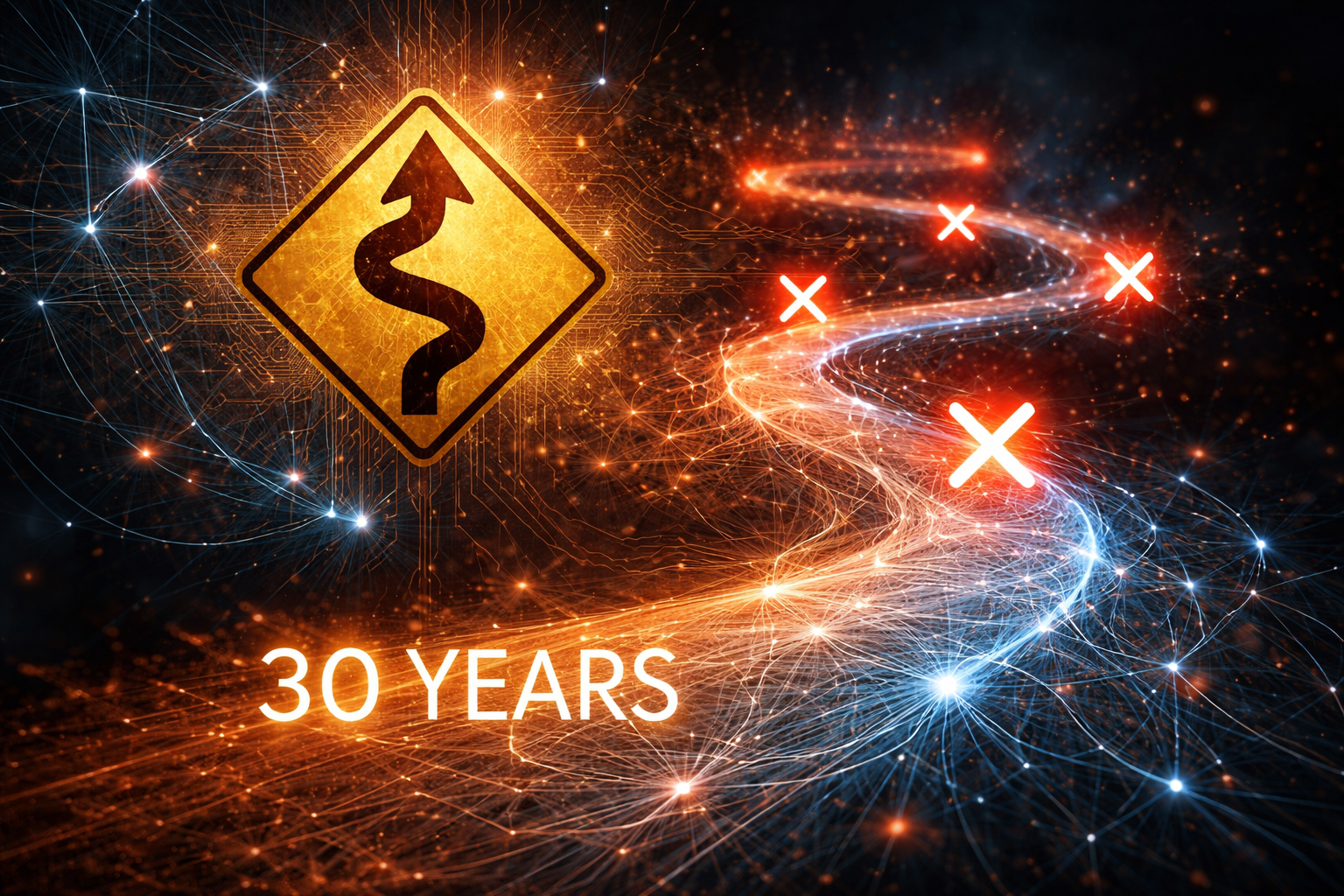
The Thirty-Year Detour: What AI Got Wrong and What Finally Changes
From Siri's debut to today's chatbots, AI has pursued pattern recognition over persistent memory—but the future lies in systems that remember and grow.
Essay · June 2026
Abstract
The AI industry has spent thirty years building increasingly sophisticated pattern recognition systems that treat each interaction as isolated, from Siri to modern language models. This fundamental approach—optimizing for impressive single interactions rather than meaningful ongoing relationships—has created artificial intelligence that performs brilliantly but lacks the persistent memory necessary for genuine understanding and relationship-building that defines true intelligence.
October 2011. Steve Jobs had been dead for exactly one week when Apple held its Let's Talk iPhone event. The iPhone 4S looked identical to its predecessor, but it carried something unprecedented: a voice that could talk back. When the demonstration showed a phone scheduling meetings and answering questions about the weather, the audience applauded politely. It felt like a nice convenience feature. Maybe even a gimmick. Nobody understood they were watching the beginning of a thirty-year detour.
What seemed significant at the time now looks like the opening chapter of AI's longest broken promise: that machines could understand us if we just taught them to recognize our patterns. From that moment forward, every major advance in consumer AI followed the same playbook. Build bigger pattern recognition engines. Feed them more data. Make them faster at matching inputs to outputs. Call it intelligence.
Siri was not intelligent. It was a sophisticated lookup table that could parse speech into commands and execute pre-written responses. But it worked well enough to convince millions of people that their phones were becoming helpers rather than tools. More importantly, it established the fundamental relationship model that would define AI for the next decade: humans make requests, machines deliver responses, and memory dies with each conversation.
The pattern held as the major technology platforms joined the race. Voice assistants followed Siri's template exactly. Better speech recognition, broader command libraries, more integrations with other services, but the same essential limitation: every interaction started from zero. These systems could recognize your voice but not remember your context. They could execute thousands of different commands but could not learn why you preferred some over others. They automated tasks without understanding goals.
The Acceleration That Changed Everything
The real acceleration began when researchers stumbled onto something they had not been looking for. Around 2018, teams training language models on massive text datasets discovered that scale produced unexpected capabilities [1]. Models with billions of parameters could suddenly perform tasks they had not been explicitly trained for. They could translate languages, write poetry, answer questions, and maintain coherent conversations across multiple exchanges.
When large language models became publicly accessible in late 2022, millions of people experienced something that felt genuinely different [2]. A system that could explain complex topics, help with creative projects, and provide thoughtful responses to open-ended questions. Within days, AI stopped being a futuristic concept and became a mainstream tool.
Yet the more impressive these systems became, the more their fundamental limitations revealed themselves. Despite their sophistication, they still operated on the same principles that powered the first voice assistants: pattern recognition and statistical prediction. They generated plausible responses by identifying patterns in training data, not by understanding meaning or maintaining genuine memory [3]. A model might perform at the top percentile on a simulated professional examination, then confidently state false information in the very next conversation [4].
The hallucination problem exposed the deeper issue. These systems were designed to predict likely word sequences, not to verify truth or maintain consistent understanding over time. They could simulate expertise without possessing knowledge, mimic empathy without feeling connection, and provide personalized responses without remembering the person. Each conversation felt fresh because, from the system's perspective, it was completely fresh.
Companies discovered this limitation the hard way. Despite massive investments in AI integration, deployments repeatedly fell short of demonstrations. One high-profile case became emblematic of the pattern: a company that publicly claimed its AI chatbot could replace hundreds of human service agents quietly rehired those people within a year to maintain service quality [5]. The story repeated across industries. Impressive demonstrations followed by disappointing deployments.
The problem was not capability. The problem was continuity. Every business relationship depends on memory, context, and accumulated understanding. Traditional AI systems, no matter how eloquent, could not maintain the thread that makes professional relationships productive.
This is where thirty years of AI development hit a wall that processing power and data scaling could not break through. The entire industry had optimized for impressive single interactions rather than meaningful ongoing relationships. Every system, from the first voice assistants through the most advanced language models, treated conversations as isolated events rather than episodes in continuing stories.
What Memory Actually Changes
The breakthrough that changes everything is not more sophisticated pattern recognition. It is the recognition that intelligence without persistent memory is not intelligence at all. It is performance.
Real understanding accumulates over time, builds context through repeated interactions, and develops insights that transcend individual conversations. This is what human relationships provide that no AI system had achieved: the ability to grow more valuable with each exchange rather than starting over.
True intelligence requires episodic memory, not just the ability to recall facts, but the capacity to remember experiences in context [6]. When someone mentions they are house hunting, that is not just a data point to store. It is the beginning of a story that unfolds over months, influenced by changing conditions, evolving preferences, and life circumstances. An intelligent system does not just remember that someone was looking for a house. It remembers why they paused their search, what made them restart it, and how their criteria shifted along the way.
This kind of memory transforms every aspect of human-AI interaction. Instead of treating each conversation as a fresh encounter, systems built on persistent memory provide continuity that compounds over time. A business AI that remembers not just what clients said but when they said it, how they responded to different approaches, and what outcomes they valued most does not just serve clients. It develops relationships with them.
The compound effect transforms how AI systems create value. Instead of measuring success by individual interaction quality, these systems optimize for relationship depth and long-term outcomes. They become more accurate, more helpful, and more trusted over time because they build genuine understanding rather than just improving response generation [7].
This shift from transactional to relational AI also changes how humans interact with artificial systems. Instead of carefully crafting prompts to get good responses, users can develop working relationships that improve through mutual adaptation. The result is AI that feels less like a tool and more like a colleague, one with perfect memory, infinite patience, and genuine investment in long-term success rather than just immediate problem-solving.
The End of the Detour
The technology industry spent thirty years building increasingly sophisticated ways to automate human requests. Every major advance improved the speed and accuracy of converting human inputs into machine outputs. These systems became remarkably good at understanding what people were asking for and delivering relevant responses.
But the future lies in systems that understand why people are asking, how their needs connect to larger goals, and what approaches work best for specific individuals over time. This requires a fundamental architectural shift from systems optimized for individual interactions to systems designed for relationship development [8].
Intelligence without memory was always artificial in the most limiting sense. Impressive but ultimately hollow. Intelligence that remembers and grows through relationship might finally deserve the name it has been given.
The thirty-year detour is ending. Whether we recognize it quickly enough to stop building toward the wrong goal is the only question that remains.
References
- [1]Kaplan, Jared et al., "Scaling Laws for Neural Language Models", arXiv preprint arXiv:2001.08361, 2020. https://arxiv.org/abs/2001.08361
- [2]Similarweb, "ChatGPT's First Birthday is November 30: A Year in Review", Similarweb Blog, 2023. https://www.similarweb.com/blog/insights/ai-news/chatgpt-birthday/
- [3]arXiv, "LLMs: A Data-Driven Survey of Evolving Research on Limitations of Large Language Models", arXiv preprint, 2024. https://arxiv.org/pdf/2505.19240
- [4]OpenAI, "GPT-4 Technical Report", arXiv, 2023. https://arxiv.org/abs/2303.08774
- [5]Customer Experience Dive, "Klarna changes its AI tune and again recruits humans for customer service", Customer Experience Dive, 2024. https://www.customerexperiencedive.com/news/klarna-reinvests-human-talent-customer-service-AI-chatbot/747586/
- [6]Moscovitch, M. et al., "Episodic Memory and Beyond: The Hippocampus and Neocortex in Transformation", Annual Review of Psychology, 2016. https://pmc.ncbi.nlm.nih.gov/articles/PMC5060006/
- [7]OpenAI, "GPT-4 Technical Report", arXiv, 2023. https://cdn.openai.com/papers/gpt-4.pdf
- [8]IEEE, "RAG-Driven Memory Architectures in Conversational LLMs: A Literature Review", IEEE Xplore, 2024. https://ieeexplore.ieee.org/document/11080430