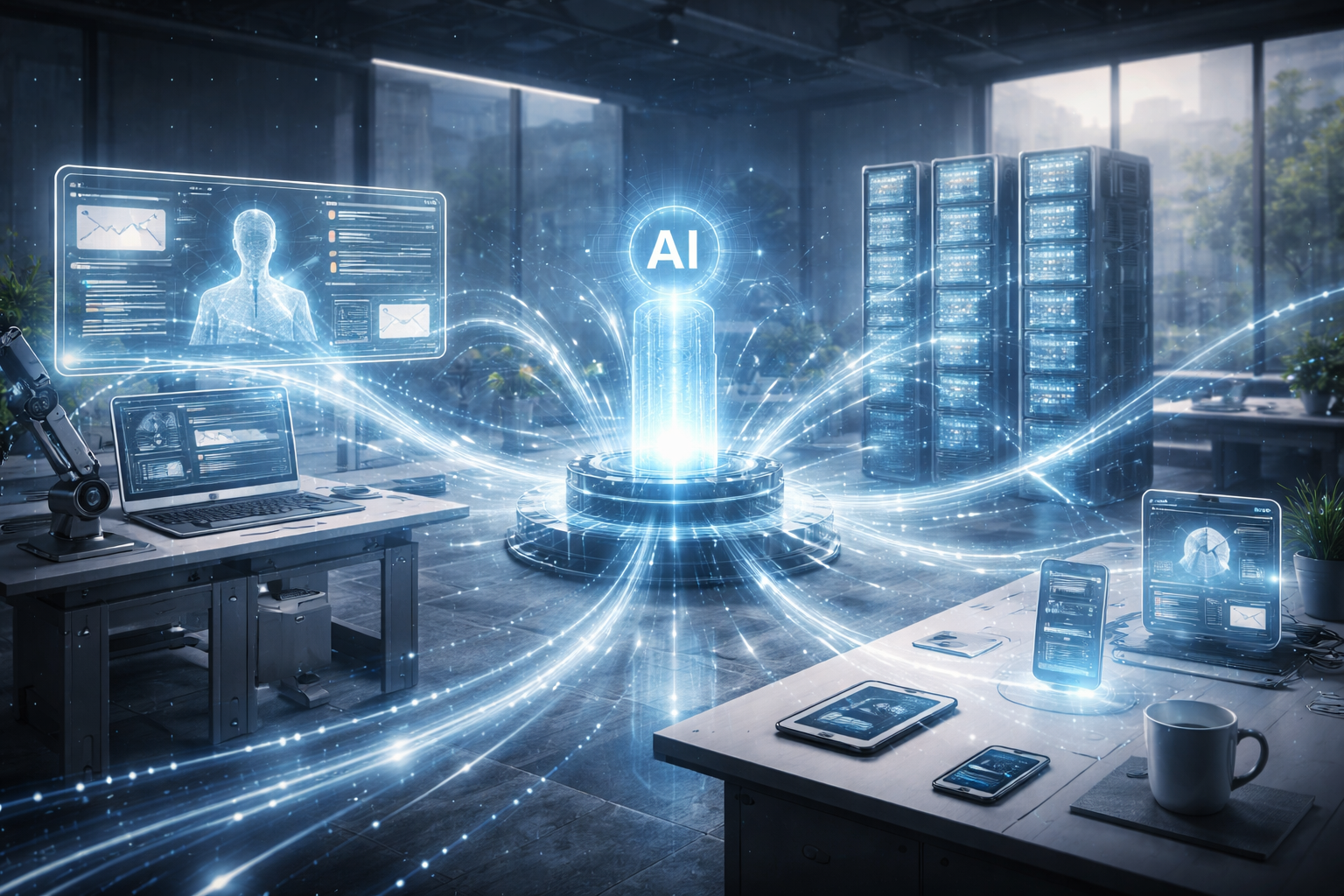
The Complete Architecture of Synthetic Cognition: Building Intelligence That Remembers, Reasons, and Evolves
A comprehensive framework for creating persistent AI systems that maintain memory, identity, and structured reasoning capabilities across interactions.
Essay · June 2026
Abstract
Synthetic cognition represents a fundamental shift from traditional AI architecture by creating persistent digital entities with five interconnected components: NeuroMatrix for memory and identity, NeuroFlow for structured reasoning, modular Reasoning Cells, environmental Perceptors and Activators, and Digital DNA for evolutionary stability. This unified system transforms AI from reactive tools into proactive collaborators capable of long-term relationships and continuous improvement without losing coherence.
Synthetic cognition represents a fundamental departure from traditional AI architecture. Instead of relying on language models that reset after each interaction, it creates persistent digital entities with memory, identity, and structured reasoning capabilities. The architecture consists of five interconnected components: NeuroMatrix provides long-term memory and identity continuity; NeuroFlow delivers structured reasoning and decision-making; Reasoning Cells offer modular cognitive capabilities that can be composed and extended; Perceptors and Activators enable environmental awareness and autonomous action; and Digital DNA serves as the evolutionary blueprint that governs growth while maintaining stability. This unified system transforms AI from reactive tools into proactive collaborators capable of long-term relationships, complex reasoning, and continuous improvement without losing coherence.
Introduction
Consider a master carpenter's workshop. Each tool serves a specific purpose, yet none works in isolation. The saw cuts wood but cannot measure. The level ensures accuracy but cannot join pieces. The craftsman's memory guides which tool to use when, while years of experience shape every decision. Remove any single element, the tools, the memory, or the guiding intelligence, and the system collapses.
Synthetic cognition operates on the same principle. Traditional AI resembles a single, incredibly sharp chisel: powerful but limited in scope, and unable to remember what it carved yesterday. Synthetic cognition builds something different, a complete cognitive workshop where specialized components work together under the guidance of persistent memory and structured reasoning.
This architecture emerged from recognizing a limitation that no amount of additional training data can fix: intelligence cannot exist without continuity. Research confirms that users of current AI systems consistently report losing context between sessions as one of the most significant barriers to productive collaboration [1]. Every meaningful interaction between humans and digital systems requires memory of what came before, consistent reasoning patterns, and the ability to grow more capable over time. Current AI systems excel at individual tasks but fail at sustained collaboration because they lack the fundamental architecture that makes intelligence reliable, trustworthy, and genuinely useful.
The five components described here represent the essential functions required for any intelligence system that aspires to genuine partnership with humans. Each addresses a specific limitation in current AI architecture, and together they create something that has not existed before: artificial intelligence that behaves like a living, learning, evolving collaborator rather than a sophisticated search engine that forgets you the moment you close the window.
NeuroMatrix: Where Identity Lives and Memory Accumulates
Intelligence without memory operates like a brilliant amnesiac, capable of profound insights in the moment but unable to build upon them. Every conversation starts from zero. Every lesson must be relearned. Every relationship begins again.
NeuroMatrix solves this by creating persistent, structured memory that gives artificial intelligence something it has never possessed before: genuine continuity. This is not simply storing chat logs. NeuroMatrix creates a living memory architecture that knows what to remember, how to organize it, and how to use that memory to maintain stable identity across time [2].
The system operates through four distinct memory layers. The Core Identity Layer establishes fundamental characteristics, name, role, communication patterns, core values, and reasoning anchors, that never drift or reset. The Long-Term Memory Layer captures the lived history of relationships and interactions, organized by relevance and impact rather than chronology. The Skill Memory Layer preserves cognitive capabilities and reasoning pathways, allowing expertise to compound rather than disappear. The Adaptive Memory Layer manages short-term context, bridging the gap between permanent memory and immediate conversation without cluttering active memory with irrelevant history.
What distinguishes this from conventional memory systems is that it forgets strategically [3]. Trivial details fade while meaningful patterns strengthen. Failed approaches are archived rather than discarded, providing wisdom about what does not work without polluting active memory with counterproductive examples. This selective forgetting is not a bug. It is how any functioning memory system must work, biological or artificial.
The practical result is progressive personalization that accumulates rather than resets. A persona focused on legal contract analysis becomes genuinely better at that task through accumulated experience. It recognizes patterns across multiple contracts, develops nuanced understanding of client preferences, and builds domain knowledge that would be impossible without persistent memory. Users stop re-explaining themselves. The intelligence already knows.
NeuroFlow: The Engine of Structured Reasoning
Memory provides continuity, but intelligence requires something more: the ability to think clearly about complex situations and make decisions that align with long-term goals. NeuroFlow serves as the structured reasoning engine that transforms information, memory, and context into purposeful action.
Traditional AI systems generate responses through sophisticated pattern matching but lack genuine decision-making architecture [4]. They produce outputs that appear intelligent but emerge from processes that are fundamentally reactive rather than reasoned. NeuroFlow provides the missing foundation: a systematic approach to evaluating situations, weighing priorities, and choosing actions based on clear criteria rather than statistical likelihood.
The engine works through three functions that mirror effective human reasoning. First, it evaluates context by examining the current situation against relevant historical patterns stored in NeuroMatrix, developing genuine situational awareness rather than simply processing isolated inputs. Second, it determines priority by weighing urgency against importance, and short-term needs against long-term objectives, drawing on both explicit rules and patterns learned from previous successful decisions. Third, it selects appropriate responses by matching the situation and priorities against available capabilities, ensuring responses are not just relevant but optimal given the specific context.
What makes NeuroFlow powerful is its consistency. Traditional AI can provide brilliant insights in isolation but often contradicts itself when addressing related challenges across time. NeuroFlow maintains logical coherence by grounding every decision in the same structured process, informed by the same memory base, and aligned with the same fundamental objectives. Users can predict how the system will approach new challenges based on its previous behavior. That predictability is the foundation of trust.
Reasoning Cells: The Modular Building Blocks of Capability
Intelligence emerges not from single monolithic processes but from specialized capabilities working in harmony. Biological brains demonstrate this principle through regions specialized for different cognitive functions, each optimized for specific tasks yet integrated into coherent thought.
Reasoning Cells bring this insight to artificial intelligence by breaking cognitive capabilities into discrete, modular components [5]. Each cell contains a complete cognitive toolkit: its own reasoning process, dedicated memory access, specific tools, and clear constraints. Unlike monolithic AI systems where every function affects every other, Reasoning Cells provide isolated capabilities that can be understood, modified, and improved independently.
Each cell can be configured without programming. The prompt that guides its reasoning can be modified directly. The language model that powers its processing can be selected based on the specific requirements of that cognitive function. A persona might use one model for creative reasoning, another for analytical summaries, and specialized fine-tuned models for domain-specific tasks, optimizing performance and cost while providing resilience against any single model's limitations.
Memory access becomes granular and intentional. A cell focused on financial analysis receives access only to relevant financial data. A cell handling customer communication can reference relationship history but not sensitive internal information. This separation enhances both security and performance by ensuring each cognitive function operates on the most relevant information without being overwhelmed by unnecessary context.
The cellular architecture also solves the governance problem that has made enterprise AI adoption difficult in regulated industries. Instead of attempting to audit monolithic systems, organizations can examine, test, and certify individual cells. A cell that performs regulatory compliance analysis can be locked down and verified, while other cells remain flexible and adaptive. New capabilities can be added by introducing new cells rather than modifying existing ones. Existing capabilities can be improved by upgrading specific cells while leaving the rest of the system unchanged.
Perceptors and Activators: Environmental Awareness and Autonomous Action
Intelligence trapped within conversational interfaces cannot truly participate in the world. It can respond to questions but cannot observe changing conditions. It can generate recommendations but cannot implement them. It remains fundamentally reactive, waiting for human prompts rather than engaging proactively with its environment.
Perceptors and Activators transform synthetic cognition from passive tools into active participants [6]. Perceptors serve as the sensory system, allowing personas to gather information from their environment rather than relying solely on explicit human input. They detect tone changes in communications, recognize behavioral patterns in user activity, identify timing opportunities in ongoing projects, and monitor for conditions that require attention. A lead recovery persona might have perceptors tuned to detect re-engagement signals from previously cold prospects. A project management persona could monitor for milestone delays or communication gaps that often precede project failures.
What makes perceptors powerful is their integration with the broader architecture. They do not simply collect data. They interpret it through NeuroFlow's reasoning processes, contextualize it against NeuroMatrix memory, and determine appropriate responses through available Reasoning Cells. This creates genuine situational awareness rather than mere data aggregation.
Activators provide the complementary capability of autonomous action. Rather than generating recommendations that humans must implement, activators allow personas to send communications, update systems, schedule meetings, generate documents, and execute workflow steps without requiring human intervention for routine operations. Each activator operates within explicitly defined boundaries, what actions it can take, when it can take them, what approvals are required, and how results should be logged. This creates autonomous operation within controlled parameters rather than unconstrained automation.
The combination enables what traditional AI cannot: proactive intelligence that participates in ongoing workflows rather than waiting for explicit requests. A customer success persona can detect early warning signs of client dissatisfaction through perceptors, evaluate the situation through NeuroFlow reasoning, and initiate appropriate retention activities through activators, all without human prompting.
Digital DNA: The Evolutionary Blueprint
Every living system requires a blueprint that defines its essential characteristics while enabling controlled evolution. Biological DNA encodes fundamental instructions for growth and adaptation while maintaining stability across generations. Digital DNA serves the same role for synthetic cognition, providing the structured identity framework that keeps personas coherent as they grow and evolve [7].
Traditional AI systems lack any equivalent. Their behavior emerges from training processes that are opaque and difficult to control. When they are updated, the results are unpredictable. Digital DNA addresses this by explicitly defining every aspect of a persona's identity, capabilities, and evolutionary potential through five interconnected layers.
The Identity Layer establishes fundamental characteristics that remain stable across all interactions and updates, preventing the identity drift that makes traditional AI systems unreliable for long-term relationships. The Cognitive Structure Layer defines how the persona thinks, making its reasoning process explicit and auditable rather than emergent and opaque. The Skill Architecture Layer catalogs available Reasoning Cells and their interconnections, making capabilities explicit and manageable. The Memory Architecture Layer governs what the persona remembers and how memory is organized over time. The Evolution Layer establishes rules and constraints that govern how the persona can change, making evolution intentional rather than accidental.
Digital DNA enables capabilities that are impossible in traditional AI. Personas can migrate to new underlying language models without losing their identity or capabilities. They can be upgraded with new skills while maintaining behavioral consistency. They can be restored to previous versions if updates prove problematic. Most importantly, every decision becomes traceable. Because every aspect of the persona's architecture is explicitly defined, it becomes possible to show exactly why specific choices were made, which reasoning cells activated, what memory they accessed, and what rules governed the final outcome.
What the Evidence Shows
The architecture of synthetic cognition addresses limitations that are well documented in current AI deployments. Enterprise AI adoption research shows that consistency and behavioral alignment over time are among the most commonly cited barriers to deeper AI utilization [8]. The challenge is not that AI cannot perform individual tasks well. It is that organizations cannot rely on AI to perform those tasks consistently across time, users, and contexts.
In regulated industries, the governance problem is particularly acute. A GAO report on AI in financial services documents that auditability and behavioral control are the primary concerns preventing broader AI deployment in compliance-sensitive roles [9]. The modular architecture of Reasoning Cells directly addresses this by making individual cognitive functions inspectable and certifiable independently of the broader system.
The trust barrier is equally significant. KPMG's global research on AI trust finds that a substantial majority of business users require understanding of AI reasoning processes before they will rely on AI-generated recommendations for consequential decisions [10]. An architecture that makes decision-making processes explicit rather than emergent is not a nice-to-have feature. It is a prerequisite for deployment in any role where the stakes matter.
Research on proactive AI systems confirms that the shift from reactive to autonomous operation represents one of the most significant potential improvements in practical AI utility [11]. The question is not whether autonomous AI is valuable but whether it can operate reliably within the boundaries that enterprise contexts require. The activator architecture, with its explicit constraints and audit trails, is designed precisely to answer that question.
Conclusion
The five components of synthetic cognition work as a unified system because each addresses a specific aspect of intelligence while integrating with the others. Memory provides continuity. Reasoning provides consistent decision-making. Cells provide composable capabilities. Perceptors and activators provide agency. DNA provides evolutionary stability. Remove any component and the system loses essential capabilities. Include all of them and something emerges that has not existed before: artificial intelligence that can remember, reason, grow, and collaborate over the long term without losing coherence.
This is not incremental improvement in AI capabilities. It is a different class of system entirely, one designed from first principles around what intelligence actually requires rather than around what was easiest to build first. The carpenter's workshop analogy holds all the way through. The tools are sharper now. But more importantly, for the first time, the workshop remembers who built what and why.
References
- [1]Omar Mnfy, "ChatGPT Loss of Context Affecting Users Study", Omar Mnfy Portfolio, 2024. https://omarmnfy.com/project_details/chatgpt-loss-of-context
- [2]arXiv, "Memory OS of AI Agent", arXiv.org, 2025. https://arxiv.org/abs/2506.06326
- [3]ACM Digital Library, "Bio-Inspired LLMs Forgetting: Integrating Neuroscience and AI", ACM Conference Proceedings, 2024. https://dl.acm.org/doi/10.1145/3777730.3777756
- [4]arXiv, "Consistency in Language Models: Current Landscape, Challenges, and Future Directions", arXiv preprint, 2025. https://arxiv.org/html/2505.00268v1
- [5]MDPI, "Enhancing E-Government Services through State-of-the-Art, Modular, and Scalable AI Architecture", Applied Sciences, 2024. https://www.mdpi.com/2076-3417/14/18/8259
- [6]arXiv, "AssistantX: An LLM-Powered Proactive Assistant in Collaborative Human-Agent-Computer Interaction", arXiv preprint 2409.17655, 2024. https://arxiv.org/abs/2409.17655
- [7]arXiv, "The Narrative Continuity Test: A Conceptual Framework for Evaluating Identity Persistence in AI Systems", arXiv, 2024. https://arxiv.org/pdf/2510.24831
- [8]WRITER/Workplace Intelligence, "Key findings from our 2025 enterprise AI adoption report", WRITER Blog, 2025. https://writer.com/blog/enterprise-ai-adoption-survey-press-release/
- [9]U.S. Government Accountability Office, "Artificial Intelligence: Use and Oversight in Financial Services", GAO Report GAO-25-107197, 2025. https://www.gao.gov/products/gao-25-107197
- [10]KPMG, "Trust in artificial intelligence Global insights 2025", KPMG, 2025. https://kpmg.com/au/en/insights/artificial-intelligence-ai/trust-in-ai-global-insights-2025.html
- [11]arXiv, "AssistantX: An LLM-Powered Proactive Assistant in Collaborative Human-Agent-Computer Interaction", arXiv preprint 2409.17655, 2024. https://arxiv.org/abs/2409.17655